Together, Bringing Christian Hope Beyond Digital Reach—Where It’s Needed Most

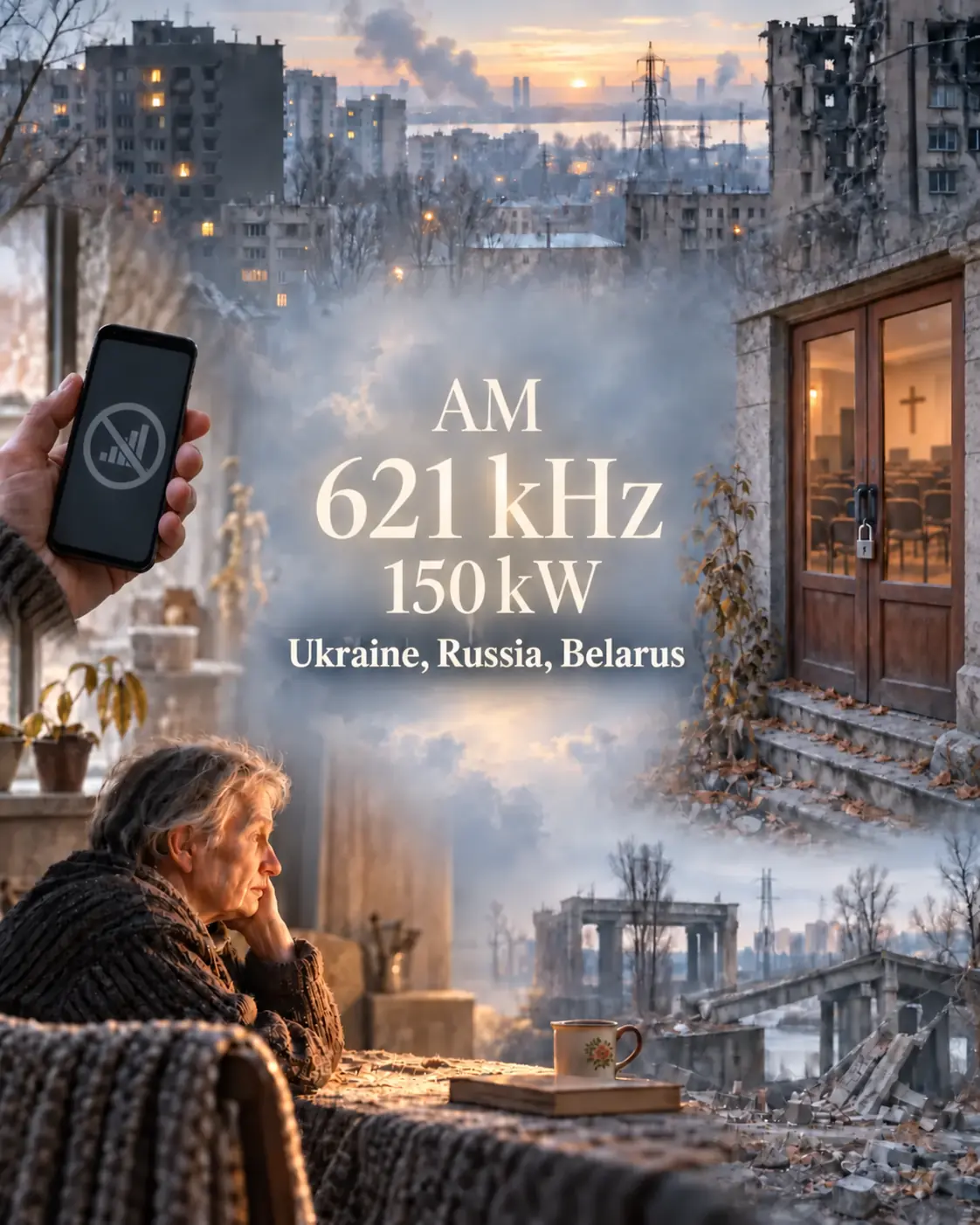
AM 621 kHz, 150 kW, serving Ukraine, Russia and Belarus, shown in a hopeful collage about disrupted communications and a closed Christian community

KCH Radio is restoring medium-wave broadcasting on 621 kHz from Moldova.

A well-known frequency across the region, with a long history of religious broadcasting.

In the evening the 150 kW transmitter will carry Christian programs to listeners in Moldova, Ukraine, much of Belarus and western regions of Russia, including the hardest-to-reach areas, where military action, occupation, shelling and communications disruptions place particular limits on access to spiritual support.

One frequency. A vast region. All that is needed for reception is an ordinary FM/AM radio or car radio. View the coverage map.

01 / Mission

What KCH Radio is

KCH Radio is an international Christian broadcasting initiative bringing together transmission infrastructure in Moldova, our studio in Belgrade and a team with 20 years of experience in international medium-wave and shortwave broadcasting.

We are creating a permanent channel through which Christian radio stations, missions, churches and theological institutions can deliver their Russian- and Ukrainian-language programs to listeners across the region.

Partners provide programs they have already produced. KCH Radio assembles the schedule, prepares material for broadcast, transmits the signal, monitors it, makes off-air recordings (airchecks) and provides technical reports.

Christian radio stations, missions and ministries from different denominations are invited to participate, provided they share the project’s editorial principle: Christian content without politics.

Medium-wave radio does not replace the internet, satellite television or local stations. It complements them wherever digital channels are unavailable, insufficiently reliable or too difficult for the listener to use.

02 / Who we serve

Who this channel is for

We are seeking to reach not merely the largest audience, but the audience that is hardest to reach.

These are people separated from church communities and familiar sources of Christian programming, without the spiritual fellowship, support and guidance they need:

  • residents of conflict zones and occupied territories;
  • families experiencing electricity and communications outages;
  • believers whose congregations have been closed or restricted;
  • older people who find apps, VPNs and streaming services difficult to use;
  • residents of small towns and villages without local Christian radio;
  • listeners who have lost access to familiar websites, podcasts and video platforms because of restrictions and blocks;
  • people for whom mobile data and additional digital services are too expensive.

A listener’s letter

Oleg, age 67*

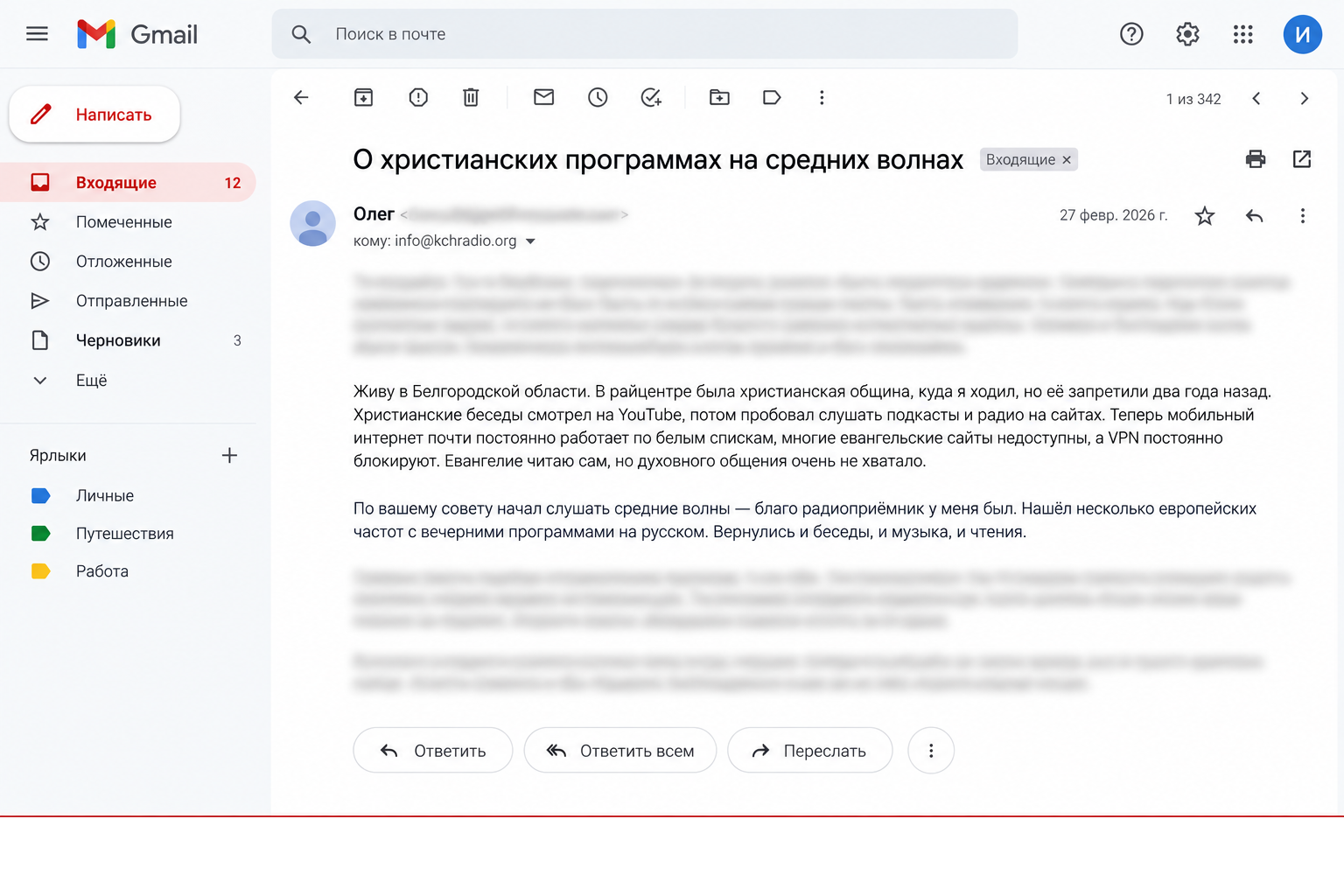
I live in the Belgorod region. There was a Christian community in the district center that I attended, but it was banned two years ago. I used to watch Christian talks on YouTube, then tried listening to podcasts and radio on websites. Mobile internet access is now almost always restricted to an allowlist of approved services; many evangelical websites are inaccessible, and VPNs are continually blocked. I read the Gospel on my own, but I greatly missed spiritual fellowship.

Following your advice, I began listening on medium wave—fortunately, I already had a radio. I found several European frequencies with evening programs in Russian. The talks, music and readings came back into my life.

* This translation of the letter is published with the author’s permission.

For someone in this situation, medium-wave radio is not an obsolete technology. It becomes the simplest available way to remain connected with the Christian world.

03 / The need for support

Why this channel is needed now

Ukraine

Military action, occupation, and damage to energy and communications infrastructure cause disruptions to electricity, mobile service and internet access. Front-line, remote and temporarily occupied areas are particularly vulnerable.

Many Christian communities have been divided; ministers and congregants have had to leave their towns, and regular participation in church life has become impossible or dangerous. People need access to sermons, Bible teaching, prayer, music and words of support even when familiar forms of communication are disrupted.

A radio signal can remain available when local communications infrastructure is unstable or entirely unavailable.

Russia

Independent Christian terrestrial broadcasting is virtually absent in Russia. As a result, most evangelical ministries can reach audiences only through the internet and digital platforms.

Blocks on websites and video platforms, mobile internet restrictions, allowlist-based network access and recurring disruptions to VPN services make foreign Christian resources difficult to use.

This particularly affects older listeners, residents of small towns and villages, and believers whose congregations have been closed or restricted. For them, an ordinary radio may be the simplest way to hear Christian talks, sermons and programs of spiritual support on a regular basis.

Belarus

Religious organizations are effectively unable to obtain licenses for their own terrestrial broadcasting. Small congregations and individual ministers face administrative pressure and restrictions on their activities.

In small towns and rural areas, the internet is not always fast, reliable or affordable enough for regular listening or viewing. Older people may also find it difficult to use apps, streaming services and tools for circumventing restrictions.

Medium-wave broadcasting creates an additional channel that does not depend on the presence of a local Christian radio station, access to a foreign website or the skills required to use digital services.

Digital platforms remain critically important in all three countries. For part of the audience, however, they can no longer remain the only way to access Christian content.

04 / A reliable communications channel

Why medium wave

A large area from a single transmitter

In the evening and at night, the 621 kHz signal travels hundreds of kilometers, covering major cities, smaller communities and rural areas across several countries.

No additional infrastructure required

Broadcasting is provided by a single transmitter and requires no additional infrastructure in the receiving countries.

Partners do not need licenses in the receiving countries

The 621 kHz frequency is assigned to the Republic of Moldova under ITU international frequency coordination and is used under an authorization issued in Moldova.

Organizations providing programs to KCH Radio do not need to obtain separate licenses or establish their own transmission infrastructure in the countries where the signal is received.

Independent of digital networks

The radio signal does not depend on local mobile operators, internet providers, video platforms, apps, cable networks or FM relays.

Simple access for the listener

An ordinary FM/AM radio or car radio is sufficient for listening.

No app, registration, subscription, SIM card, satellite dish, VPN or internet data is required. The listener simply selects the AM band and tunes to 621 kHz.

Available during outages

Portable battery-powered receivers and car radio systems can operate when electricity, mobile service and internet access are unavailable.

05 / Broadcast geography

Coverage area

Moldova · 621 kHz · 150 kW
Estimated night-time propagation

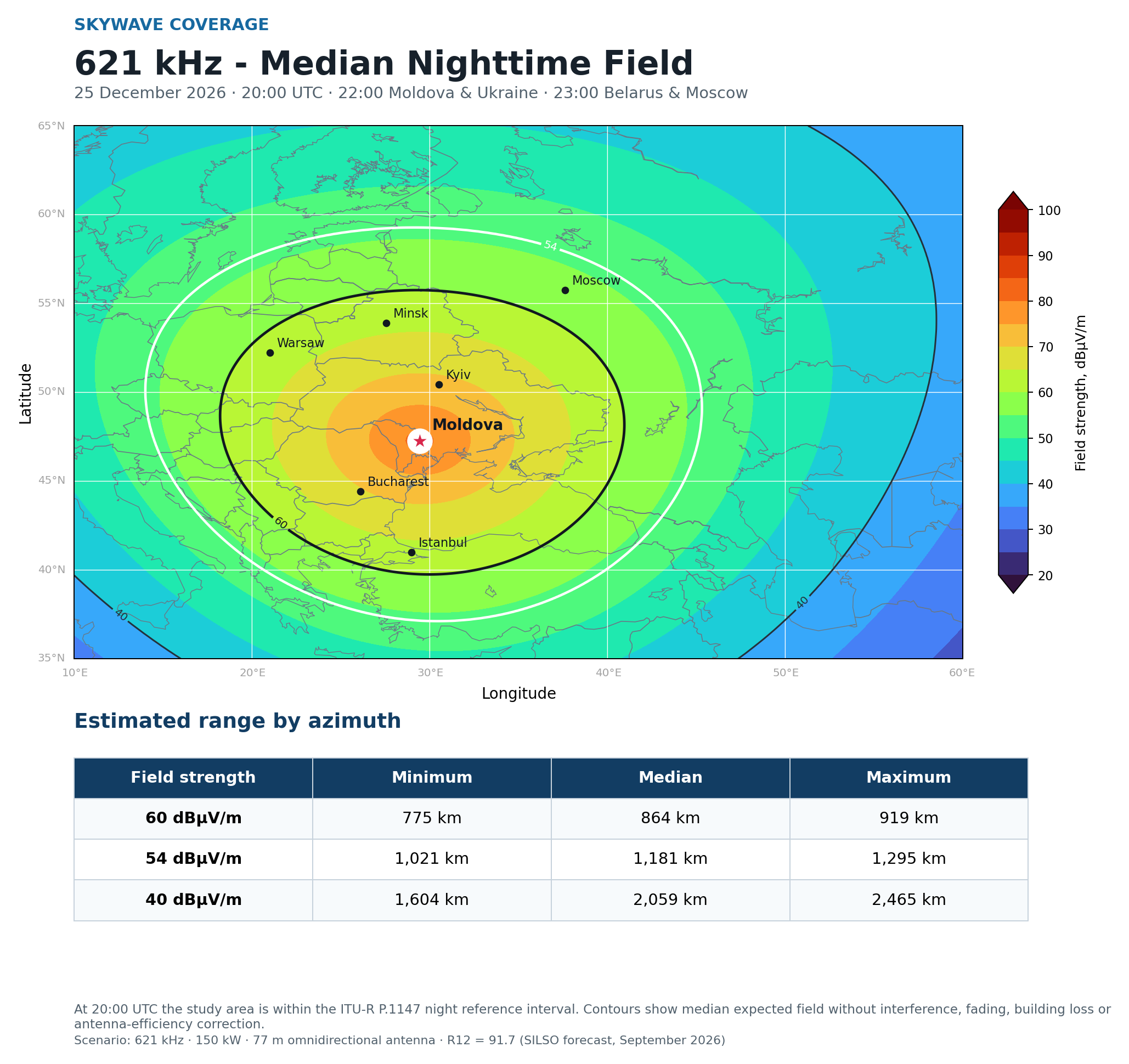
Estimated KCH Radio night-time signal propagation on 25 December 2026 at 20:00 UTC Enlarge map
Calculation scenario: 25 December 2026 · 20:00 UTC · 22:00 in Moldova and Ukraine · 23:00 in Belarus and Moscow.

The map shows the estimated median night-time signal field. Actual reception quality depends on local interference, propagation conditions, the receiver and its antenna.

Open technical parameters

06 / Audience development

Helping to build an audience

KCH Radio does more than put a signal on the air. In addition to our own partner network, developed through earlier humanitarian projects, we maintain a verified contact base of parishes and Christian communities in Ukraine and Russia, with some contacts in Belarus, as well as a base of listeners who have communicated with us previously.

Before regular broadcasting begins, we will contact these communities and provide ready-to-use announcement copy, the frequency, schedule and simple instructions for tuning an FM/AM radio, asking them to include the information in community mailing lists or chats and inform their congregations as widely as possible.

For their part, partner broadcasters can announce the programs to their online audiences at the same time.

Together, these efforts will help build strong awareness among the potential audience through online communication and word of mouth within local Christian communities.

Reports from communities and listeners, together with remote SDR monitoring, will enable us to assess both signal availability and the development of a real audience. We do not promise a ready-made mass audience from day one, but we do offer an organized process for developing that audience and gathering feedback.

07 / Shared ministry

Why we are creating a partner channel

Our team’s core expertise lies in organizing broadcasts, operating transmission infrastructure and verifying signal propagation. Our aim is not to become a major producer of Christian programming.

On our own, we could prepare only a limited daily service. A single hour of programming per day would match neither the scale of the audience’s needs nor the transmitter’s capacity.

Christian radio stations, missions, churches and educational institutions already produce high-quality programs, understand their listeners and possess the necessary theological, editorial and pastoral expertise.

We have therefore chosen a partnership model:

  • KCH Radio provides the broadcast channel, technical expertise and complete operational support;
  • partners provide the programs;
  • together, we create a complete and varied evening schedule.

The transmitter thus becomes a shared channel rather than a station belonging to a single organization, enabling different Christian ministries to reach people who no longer have reliable access to spiritual fellowship, support and guidance.

08 / On-air tests

The first step together

As a first step, we are offering interested mission organizations an on-air test fully funded by KCH Radio.

A partner may broadcast a 15- or 30-minute program every evening for one or two weeks.

These broadcasts will allow us to assess together:

  • the actual reception area;
  • signal quality in different parts of the region;
  • whether medium wave is suitable for existing programs.

We plan to verify the test broadcasts through three complementary channels:

  1. Technical broadcast-monitoring systems, including KiwiSDR and IBB RMS.
  2. Our own monitoring in Russia, Moldova and Belarus, together with reports from partner communities.
  3. Independent monitoring by the DX community at our request.

KCH Radio will take responsibility for scheduling, program preparation and transmission, technical supervision, signal monitoring, airchecks and the final report.

To take part, a partner need only select and approve an existing Russian- or Ukrainian-language program and upload the audio file or provide a link to it. There is no need to produce a special program for the test.

At the end of the test, the partner will receive:

  • off-air recordings;
  • results from remote SDR monitoring;
  • information on the observed reception area and signal quality;
  • a concise technical report;
  • recommendations regarding possible continuation.

The test carries no automatic extension or financial obligation. The possibility of regular broadcasting will be discussed separately after the results have been assessed.

09 / Transparent terms

Principles of long-term partnership

Regular broadcasting on 621 kHz is planned to begin at Christmas 2026. An information campaign among Christian communities and associations is scheduled to begin six weeks before the start of regular broadcasting.

Partners that remain interested in the project following the test will be offered the opportunity to include their programs in the information campaign and move to regular broadcasting. KCH Radio will fund the first ten days of regular broadcasting for each partner. Thereafter, each partner will contribute to the transmitter’s operating costs, which we cannot fully cover ourselves, in proportion to the actual airtime used by that partner’s programs.

With sufficient overall use of the transmitter, our preliminary calculations indicate that a partner’s cost will be approximately USD 1–1.15 per minute actually broadcast.

Partners pay at the end of each month, only for airtime actually used. No advance payment is required.

We will set no minimum daily or weekly broadcasting commitment.

We will not insist on long-term agreements. A partner may stop broadcasting at any time, subject to reasonable advance notice.

10 / From testing to regular broadcasting

Roadmap after the test

1. Build the regular schedule

After the on-air tests, we will agree broadcast times with the organizations that decide to move to regular broadcasting and combine their programs into the channel’s overall schedule.

2. Begin informing the audience

KCH Radio will contact the parishes, congregations, preachers and missionaries in its contact base. At the same time, participating broadcasters will be able to tell their audiences about the 621 kHz frequency and their program times.

3. Regular broadcasting planned from December 25, 2026

KCH Radio will fund the first ten days of regular broadcasting for each partner. The project will then move to a partnership model for covering operating costs.

11 / Experience and origins

How KCH Radio began

Members of our technical team have spent twenty years helping to organize religious and international broadcasting on medium wave and shortwave. Transmission facilities in the region carried programs to different countries and language audiences.

After 2022, some of these specialists decided to end their involvement in news and political broadcasting and apply their accumulated experience to creating an exclusively religious radio service.

A standalone medium-wave transmitter was obtained under a long-term lease, subject to retaining two hours of daily broadcasting for a regional public-service channel. The team reconfigured the 77-meter non-directional antenna and prepared the transmission system for operation on its own.

The 621 kHz frequency is allocated to the Republic of Moldova and has a long history of religious broadcasting. Written authorization has been obtained to use the transmitter exclusively for religious programming.

The technical team was joined by Know Christ Herald, a religious educational initiative from Serbia with its own studio in Belgrade.

This is how KCH Radio began: a group of people who understand international radio from the inside and seek to restore a reliable channel of spiritual support on 621 kHz for one of Europe’s most challenging regions.

We do not provide news or political broadcasting. KCH Radio will carry Christian talks, sermons, Bible teaching, music, readings and programs supporting people facing difficult circumstances.

12 / Value for partners

What a partner receives

  • access to an additional, interested audience without having to arrange program delivery to listeners independently;
  • the ability to reach people whom digital platforms do not always reach;
  • the ability to use Russian- and Ukrainian-language programs that have already been produced;
  • support in building an audience through KCH Radio’s contacts, its base of parishes and Christian communities, and a joint listener-information campaign;
  • program preparation for broadcast and complete technical support;
  • airchecks and objective monitoring data on reception area and quality;
  • participation without constructing a transmission network or obtaining licenses in the receiving countries;
  • a clear path from a free on-air test to possible regular broadcasting.

Together, Bringing Christian Hope Beyond Digital Reach
—Where It’s Needed Most

If your organization has Russian- or Ukrainian-language Christian programs and shares the project’s aims, we would be pleased to discuss including them in the first on-air tests.

We will send a concise project description and estimated coverage map, and suggest a possible evening broadcast time.

Contact: info@kchradio.org

13 / Engineering data

Technical parameters

The initial engineering study shows the expected propagation of KCH Radio’s signal on 621 kHz during the evening and night.

Core parameters

Parameter Value
Frequency 621 kHz
Power 150 kW
Antenna A-7, 77 m, non-directional pattern
Calculation scenario 25 December 2026; 20:00 UTC; 22:00 local time in Moldova and Ukraine; 23:00 in Belarus and Moscow
Solar activity R12 = 91.7; SILSO forecast, September 2026 release

Estimated coverage area

After dark, the estimated range is approximately 864 km at a field-strength level of 60 dBμV/m and approximately 1,181 km at 54 dBμV/m.

View the coverage diagram

Reference locations

On a small screen, scroll the table horizontally.

City Distance Estimated night-time field Reference
Chișinău 52 km 80.2 dBμV/m Strong
Odesa 133 km 78.5 dBμV/m Strong
Kyiv 361 km 71.3 dBμV/m Strong
Lviv 488 km 67.7 dBμV/m Good
Minsk 748 km 60.7 dBμV/m Good
Moscow 1,098 km 54.0 dBμV/m Moderate

Strong — above 70 dBμV/m; Good — 60–70 dBμV/m; Moderate — 50–60 dBμV/m.

References are indicative: actual reception depends on interference, the receiver and its antenna.

On-air verification

Before regular broadcasting begins, the estimated coverage area will be tested on air using remote SDR receivers. Partners will receive airchecks and a concise report.

Download the complete engineering study

Coverage map
621 kHz

100%
Original estimated 621 kHz night-time field diagram with legend and range table